Thursday, September 14, 2006

Going the Extra TEN Miles

Antique bridle rosette pin or brooch, horse head Yesterday I had an interesting email from a close friend. She's an antiques dealer who sells regularly on the Internet through a well-known non-auction webstore site.

She'd sold several items to a customer and shipped them. One of the items was a matted and framed picture, which she placed in it's own separate box and marked in very big letters on this box "PICTURE ENCLOSED". All the items to this customer were shipped in one large box.

The customer received the package, and emailed the dealer, asking when she'd be receiving the picture. The dealer emailed back explaining that the
picture was with the other items in the large box, and explained in detail how she'd packaged the picture in it's own box marked "PICTURE ENCLOSED."

Apparently, the customer has tossed out that box. The picture was gone forever.

The dealer thought about it a bit, and decided to refund the customer's money for that picture. She certainly wasn't obligated to do so; this was a mistake made by the customer, who admitted she was probably more responsible than the dealer for this mistake. (I'm not even going to address that statement . . . )

The dealer had done a good job of packaging, including clearly marking the internal packaging. She'd gotten the entire purchase there safely and in good condition. Her decision to refund the customer's purchase price on this lost picture was something few dealers would have done, since it presented lost income. Not just money lost from the dealer's original investment in that picture - since she refunded the entire price, she also lost the profit that thrown-away picture represented.

It wasn't an expensive item. Still, most dealers would have just told the customer that they did something really dumb, and sorry, but it was your responsibility to not throw away your purchases. But my dealer friend recognized that honest mistakes happen, and was sympathetic enough to commiserate with the customer and return her money.

My dealer friend asked me two questions. First, what would happen if the thrown-out purchase had been worth a much larger sum? And second, what would I have done in the same situation?

I told her my opinion, for the two cents it was worth. I would have done what she had done, and chalked it up to the "Customers Doing Goofy Things" file. Had it been a purchase worth a lot more money, I would have handled it differently. I would given her my condolences, and would have tactfully and politely explained that I was sorry for her loss but that I could not be responsible for a customer throwing away an item that I'd carefully marked and safely delivered. And, no, I would not have refunded her purchase price on an expensive item.

However, my dealer friend had gone the extra TEN miles for this customer (a new customer, I should mention). By doing so, she had forever has impressed upon that customer that she was buying from a VERY reputable Internet dealer who understood human error happens occasionally. My dealer friend had responded in a very kind and decent way.

That refund cost the dealer some money, yet made a very big impression. Shortly thereafter, that same customer purchased two more items. She's probably a customer-for-life, and - if she's a really, really nice person - she'll tell her friends and family this story.

If you would like to know more about this dealer and see what kinds of things she sells, go to her website.

Meet my good friend Dexter. I am so proud of her, and am honored to share a wonderful friendship with her. She is truly a gem.


Wednesday, September 13, 2006

Funny Signs

Okay, I just couldn't resist - these signs were all sent to me by my daughter-in-law, and they are sooooo funny!! Thanks, Shannon, for sharing these!


Wednesday, September 06, 2006

Auction Action in Maine - Kaja Veilleux


So many auctions, so little time! Nearly any day of the week, somewhere in Maine there's an antiques auction. It might be a weekly Sunday morning local auction, or a bi-weekly consignment auction, or an on-site once-in-a-lifetime old family farm auction, but it's not difficult to find auctions to attend in Maine.

Dealers love auctions. Not only is it an opportunity to buy fresh stock, but it's a lovely way to spend a day socializing with other dealers and catching up on news (and gossip
). It's pure good luck if you come home with something new to add to your inventory, since buying is super-competitive, and it's possible you may spend an entire day at an auction and buy absolutely nothing. Attending auctions is just part of a dealer's life, and if the gods are smiling and your wallet isn't too tight, you might actually be successful.

One of the premier auction houses along the Maine mid-coast is the Thomaston Place Auction, which only offers about a half-dozen or so sales a year. The quality is some of the best to be found in New England, and auctioneer/owner Kaja Veilleux - known locally just as "Kaja" - knows his trade well. He consigns early New England furniture and decorative accessories, folk art, marine-related antiques, high quality jewelry, toys, dolls, paintings, and similar good antiques, all designed to bring in the heavy-hitting buyers. It's a formula which works well for him, and over the years he's built a well-recognized auction house based on his ability to accomplish strong sales prices.

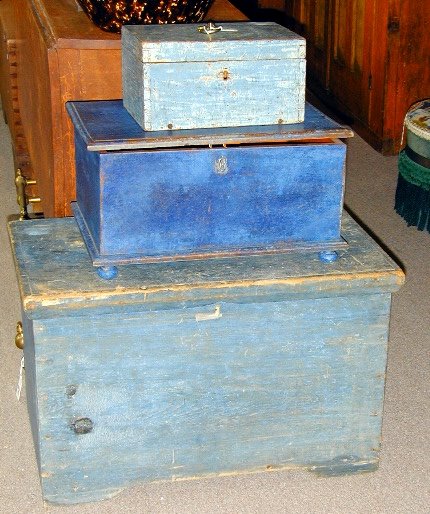
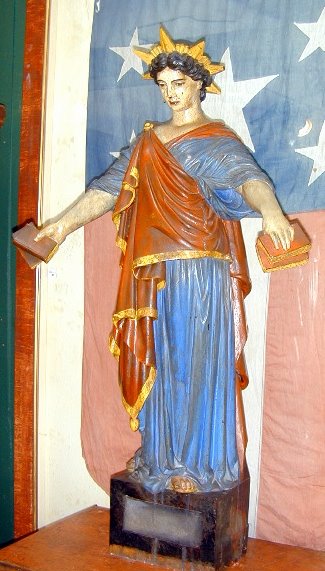
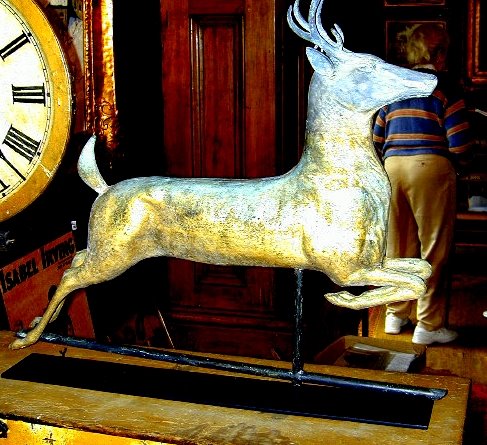
I previewed his most recent auction a couple of weeks ago and took a few photos with permission, since I was writing a free-lance story for an antiques trade paper. Take a look at the photos and prices, and you'll know why Kaja has such a large following of dedicated auction-lovers who want rare antiques.

The quality was there, and the antiques appealed to big-ticket buyers. There were plenty of items sold at much less money than shown here, but I thought you might like to
see what some really good old stuff sells for at auction in Maine.

In the middle of the page, the 42" tall, circa 1870s, hand-carved from wood figure was made by an unknown ship-builder. She's Lady Liberty, and is all original surface, with outstretched hands holding books. She is fabulous and one of a kind - and was truly appreciated to the tune of $35,000.

At the top is the stack of three 19th century boxes in old blue paint, which sold for $1800 as a group.

And the rare leaping 19th century stag full-bodied weathervane, in beautiful original gilt paint, was estimated to sell for between $18,000 to $22,000, and brought $25,000.

Tuesday, September 05, 2006

Funny Signs are my favorites


By now you know that I just love funny signs, as you've seen others in my blog. Here's a new one I've added to my Funny Sign collection. I don't know where this was taken, but I can surely appreciate sitting in a long line of traffic, just hating the guy who wrote this sign!

Sunday, August 27, 2006

I love Maine because . . .


Some of the things I love best about Maine are everyday things, just little bits and pieces I've noticed. LIke some of these . . .

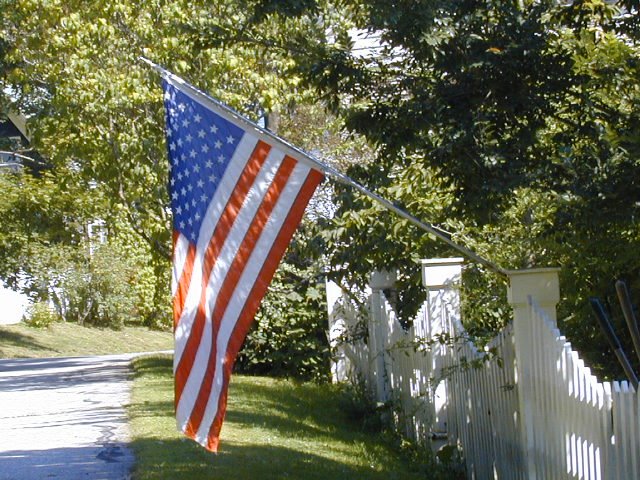
. . . Mainers are patriotic. Not just for the Fourth of July and for Memorial Day, but all year around. I see U.S. flags flying proudly in front of homes, on porches, on trailers, in front of stores, on fence posts, in wide open fields, and in places you might not normally expect to see flags. Mainers love their country and want everyone to know.

. . . Mainers are non-stop hard-working people. Vivian Libby is 80-years-old and is still cutting hay on her 1948 International Harvester, which she bought new back in 1948. She works her son's farm in Newcastle, just a few miles from my home. Women in Maine have a long tradition of working their farms, and most can't imagine "retiring". It's just their life style. Vivian didn't even stop cutting hay when the local newspaper photographer showed up to take her photo for the LIncoln County News, so all the photographer could get was a distant shot of her driving her tractor across a huge field of hay bales!

. . . Mainers are courageous. A local man was fixing his neighbor's roof, when friends came over to tell him that they'd noticed a family of four vacationers hadn't returned from a morning's sailing trip. The man, a former Navy Seal, realizing the approaching storm had brought rough seas, hopped into a boat and went searching for them. He found the husband and wife with their four-year-old twins clinging to their overturned sailboat. They'd not looked at the weather reports and had not anticipated serious weather before going out. They hadn't told anyone exactly where they'd be sailing. They had no communications, and after their sailboat overturned in strong winds and heavy seas, had been in the cold sea water for more than an hour. He brought them into his boat, brought them AND the sailboat back to shore. He saved their lives. They were strangers to him, but he cared. And then went back to work on the roof . . .

. . . Mainers have a sense of humor. Over the last few months I've photographed several different kinds of home made signs, some funny, some serious (see my blog of 8/18/2006 and the blog on the Beau Chemin farm). Mainers don't mind sharing their opinions through signs, and they don't care what others think of their signs.

. . . Mainers are polite and helpful. Often it can be difficult to get into Route 1 traffic in July and August, as there are long lines of vacationers. Route 1 is the main north-south route through the coastal communties, and there just isn't an alternative driving route. Locals hate the long waits in traffic, but also realize that without all those people coming into the area, they wouldn't be seeing the dollar amounts spent in restaurants, gas stations, grocery stores, antiques shops, boutiques and other places which sustain Maine's tourism industry. So they grin and bear it, and they regularly stop on the highway, make a break in the traffic line, and wave others in from the side roads and business driveways. Always with a friendly wave and a smile . . .


Friday, August 25, 2006

Bakelite Jewelry - Information and How to Test


Bone colored Bakelite Dog Head pin
If you like Bakelite jewelry, you know how expensive it can be. You'll want to know a bit of history so you can buy with knowledge, and also how to test to be certain you are really getting Bakelite.

Bakelite was created by Dr. Leo Baekland around 1909, when he was experimenting with elements to creat a new varnish. He used phenol and formaldehyde under pressure and heat, and inadvertently discovered the first plastic ever made from polymers - Bakelite!

His new invention produced durability and hardness as well as heat resistence. Because of it's versatility, it was sometimes called "The Material of a Thousand Uses". One of it's best properties was that it was castin a mold, it couldn't be melted.

The 1930s were the heyday of Bakelite jewelry. It was not expensive, and during the Great Depression it was used in a wide variety of ways to copy natural materials like tortoise shell, ivory, amber and other higher cost jewelry. The most carved or brightest or multi-color pieces of Bakelite were very desirable during those years of the Depression. Now they are hard to find and bring the biggest prices!

Bakelite Testing Methods

There are dos and don'ts of testing Bakelite. Here are some suggestions.

Dont's:

Hot Pin Method - Some people still think that it's okay to use a the sharp point of a red-hot pin to test Bakelite. The belief is that since Bakelite is heat-resistant, it won't burn or melt when the hot pin is applied.

However, if one applied a red hot pin to Bakelite, it won't melt but it will show a dark mark at the point of contact. A heated pin means either that - if it's not Bakelite - it will melt anad therefore damage the item, OR, if Bakelite, it will show that permanent dark mark. Either way, the item is greatly devalued with this test.

Scrubbing Bubbles - Many believe that applying the bathroom cleaner Scrubbing Bubbles is the answer to testing Bakelite. Not so. Rubbing Bakelite with this cleaner can get you a yellowish streak on the applying cloth, telling you that it is genuine Bakelite. However, it also can mean that you just have dirt on a plastic jewelry piece that happens to be yellowish - as in nicotine from a smoker's home. Unfortunately, Scrubbing Bubbles is a harsh chemical and strips the finish from Bakelite. This makes a nice shiny original finish now a dull, lack-lustre finish. This method of testing is definitely not-recommended.

DO Use these Testing Methods

The 409 Method - This is one of the more widely accepted tests for Bakelite jewelry. Using a cotton swab, apply the cleaner 409. You will get the yellow streak associated with real Bakelite. Be sure to first wash the piece being tested with mild dish detergent and warm water, so the streak you are looking for isn't dirt. Don't soak the piece in water - it may weaken the glue holding the findings. Just wash it quickly and dry it immediately. The yellow streak can be anything from pale yellow to a rich yellow-orange, but on a clean piece of Bakelite, it's a good way to test for the real thing.

Simichrome Polish - Another good test is using the silver cleaner Simichrome Polish. A little bit goes a long way - you don't need much. Again, you are looking for a yellow streak to show it's Bakelite. Don't forget to wash your test piece first.

Even better, using Simichrome means that you'll be polishing your test piece. Even if it's not Bakelite, it will look better being polished to a shiny finish!!

simi.jpg (17787 bytes)


Monday, August 21, 2006

Fun Visit to Beau Chemin "Antique" Farm!


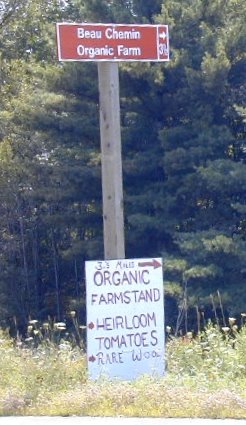
Driving up coastal Route 1 the other day, I noticed a handlettered sign saying "Organic Farmstand - Heirloom Tomatoes". That was enough to catch my attention, and my van made a right turn down that two-lane blacktop road nearly all by itself.

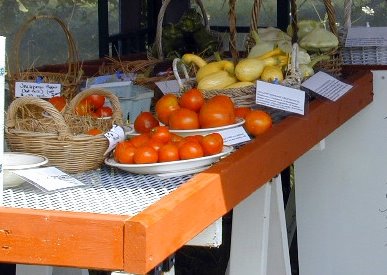
What a joy to find real veggies! None of that boring, tasteless stuff you see in the grocery store. These were al
l picked that morning - the freshness was so wonderful, you could smell the richness of the tomatoes! And I bought several kinds of heirloom tomatoes, had them for dinner, and now will make it a point to buy them as often as possible.

Beau Chemin Farm offers organic vegetables, and if you want to actually see
where these are grown, you only have to walk about 100 feet from the stand to see their 18 kinds of historic tomatoes from the 19th century. Also in this large patch are eggplant, a variety of squash, cucumbers, peppers, raspberries and more.

I met the owner Jo Ann Myers, who was digging in her garden and at that moment battling tomato horn worms. Being organic means no spraying of her plants, and she was individually picking off the darned things, a very time consuming task. They ar
e the length of your index finger, and a royal pain to eliminate, since where you find one you'll find a half dozen hidden in the tomato leaves. They look much like the plant stalks, very green and thick, and it's easy to miss them. They are giant caterpillars, not worms, and if they didn't decimate a tomato plant overnight, you might even consider them pretty. I don't, since I lost 3 plants this summer to them, and have barely managed to save the other six plants in the tomato patch. They'll eat all the leaves and some of the green tomatoes too. I detest them.

Anyhow, I digress. The Beau Chemin Farm is unique in that they specialize in not only
heirloom vegetables and flowers, but also raise endangered heritage breeds of livestock. They are a working farm that is open to the public for self-guided tours, and they have several different kinds of farm animals, including sheep, chickens, ducks, cows and draft horses.

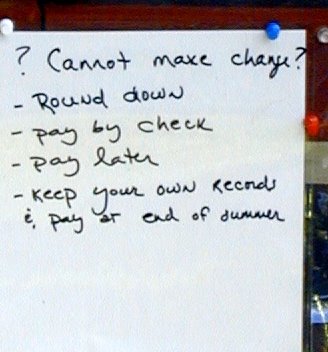
Now here's something a bit different - take a look at the sign they've posted at the veggie stand about payment. If you cannot make change (and there was plenty of coin change in a small plate on the table), there were other options listed on their sig
n. These are true Mainer farmers - they work their farmstand on the honesty system - if you don't have the money at the moment, they'll even let you run a tab!!!

This is such a wonderful place to tour, a great place for an afternoon of family fun. I hope
to get back soon for my own tour - didn't have enough time before, and now want to get back to see the antique barns and "vintage" animals!

Friday, August 18, 2006

The Story behind the Sign


In Sheepscot, Maine, after months of construction, a new bridge was opened. Sheepscot is a rural village, with just a few dozen homes on either side of the Sheepscot River. There's no main street, no commercial businesses - it's just a simple, quiet, residential village with a two-lane blacktop road running through it.

This road is often driven by knowledgable locals who use it to get around long traffic lines on Route 1 during the busy tourist season. By driving through Sheepscot and across the new bridge, one can cut 20 minutes off the bumper-to-bumper, snail's pace five-miles-an-hour traffic jam on Route 1 in mid-coast Maine. Few tourists know about this shortcut.

Apparently, a few locals have been driving too fast for this quiet little village, and this particular villager isn't happy about it. This sign was recently erected, and it certainly catches your attention!!

Mainers do speak their minds . . .

Monday, August 14, 2006

2007 Lobstering Women of Maine Calendar

JANUARY 2007Brittany Dunbar
Bet you never gave a thought as to who catches all those lobsters in Maine. Though it's mostly a male-oriented trade, there are women up and down the coast who set and pull their own lobster traps for a living. Their decidedly independent spirit is shown in the 2007 calendar, "Lobstering Women of Maine". It's a high quality, full color 12 month calendar,

No, these women don't pose au naturel. They don't even pose in bathing suits. These are hard-working, serious and dedicated professional fisherwomen who are shown in their work clothes along coastal Maine settings.

If you are looking for something different and colorful, this is a fun calendar. Click here for ordering information (and yes, there's a 2007 Bachelor Lobstermen calendar available too!).

Wednesday, August 02, 2006

Maine Lobster Festival!!!

With the extreme heat across the entire United States, today's a great day to stay inside in a cool place and wander the Internet. If you get a chance, look at my Ruby Lane shop - I've added quite a few fresh antiques I've recently found.

Or have a wander through the Maine Lobster Festival, which starts today through this weekend.

The Lobster Festival is huge, and only about 25 miles from my home. It's a HUGE amount of fun, and who would have ever imagined how much entertainment you can conjure up with a lobster theme!

Maine Lobster Festival - Photo #47 Parades, a Lobster Queen (no, she doesn't have to dress up like a lobster), the lobster crate run (with this week's heat, there's going to be a whole bunch of people entering this one - you run across a path of plastic lobster crates tied together in nice, cool Penobscot Bay), the human-sized Giant Lobster Trap, and of course - eating lobster, lobster, and more lobster - there's lots to do at the Lobster Festival.

By the way, the hot news in the lobster fishery this past few weeks has been the rare colors of lobsters which have been caught by local lobstermen. Lobsters are usually mottled green in their natural state. The only turn red when cooked.

A couple weeks ago an unusual 2-color red & green lobster was found in a trap. Talk about weird - it looked like someone had dyed this lobster. It was red on one side, and green on the other, as if a color line had been drawn down it's center lengthwise. It could have been a Christmas Lobster!

Then a couple of blue lobsters have been found recently - very, very rare.

And today, it was announced that not one, but TWO yellow lobsters have been discovered, each in different places miles apart. It's estimated that the chances of a yellow lobster being caught is 1 in 30,000,000. I know it's a true color rarity, but that yellow lobster looked pretty anemic to me.

No one eats these rare-colored lobsters - they end up in a tank somewhere like a restaurant or store, to be viewed and enjoyed by the public.